
Round rules
How to play Falling Pickaxe from the stake to the end of the round
A Falling Pickaxe round starts with a stake and a reel. If a pickaxe has landed, it falls by itself until the durability runs out. The result arrives at the end. The path is not steered with the cursor.

Contents
- How to play Falling Pickaxe from the stake
- The reel in Falling Pickaxe decides whether there will be a fall
- Pickaxes and HP when you play Falling Pickaxe
- Blocks and payouts when you play Falling Pickaxe
- The end of a Falling Pickaxe round at zero HP
- TNT, the arrow and the crafting table in the game Falling Pickaxe
- How to play Falling Pickaxe, not the way crash is played
- Speed-up when you play Falling Pickaxe
- The order of how to play Falling Pickaxe before the stake
- What to read on the Falling Pickaxe screen during the descent
- Mistakes when you are learning to play Falling Pickaxe
- The chain of how to play Falling Pickaxe
How to play Falling Pickaxe from the stake
How to play Falling Pickaxe, if you reduce it to a single gesture. You set the stake amount and you press launch. Everything below that click, you no longer steer. There is no line that has to be assembled. There is no cell that has to be opened with a finger. There is a sum on the panel and a reel that will now decide whether a fall happens at all.
The Pixmove card does not publish a minimum and a maximum stake. I do not copy other people's figures from catalogues into this. The numbers on your panel are the ones that are correct. If the plus button is hiding behind someone else's window, move the window first. A stake that you do not see in full is already a bad start.
The stake amount scales the calculation. It does not choose the pickaxe and it does not make the next descent an obligatory plus. The x160 ceiling remains a ceiling both on a small sum and on a large one. What grows is the possible figure of the result, not the generosity of the shaft.
Short rounds are easy to click one after another. That is why a limit on the sum and on the time is better written down before the first series, not after. Raising the stake right after a loss does not create an advantage. The overall picture of the game lies in the Falling Pickaxe review. Here it is already the order of the hands.
The reel in Falling Pickaxe decides whether there will be a fall
After the launch, a single reel plays out. On it there is either a cross with no tool, or a wooden, stone, iron or diamond pickaxe. A cross closes this launch. There is no mine, there are no hits, and the stake of the empty move is deducted. A pickaxe opens a vertical descent.
You do not set the direction. Picture a tube into which a weight has been dropped. Where it strikes is decided by the filling of the tube, not by your cursor. If you want to "nudge it left, the gold is over there", that button does not exist. The gold either stands on the path, or it does not.
Seven crosses in a row are, by the rules of the interface, closed by an eighth launch on which a pickaxe is obliged to appear. This is not a payout mode and it is not a promise of an emerald. The obligation is a single one. To show a tool. Which of the four, and what lies under it, the rule does not assign.
Before the seventh cross, do not keep a tally of "they owe me". A sixth empty reel switches nothing on. The history of the previous crosses does not draw the next route. If the help of your build phrases the series differently, the help is the correct one, not this paragraph.
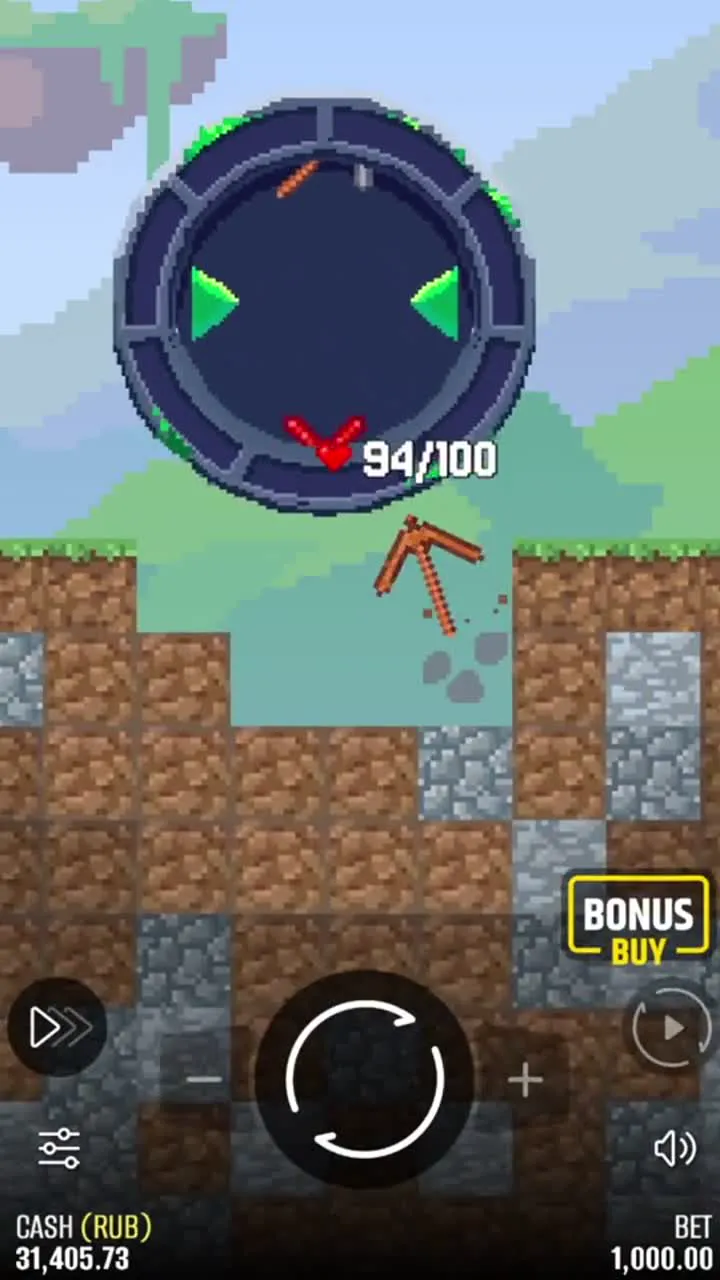
A cross when you play Falling Pickaxe
An empty reel is easy to flick past as "the round did not start". It did start and it did end. The stake of this launch has already been played.
Do not speed up the next clicks as if you have to catch up what was lost. The reel does not keep a journal of your annoyance.
Pickaxes and HP when you play Falling Pickaxe
If a pickaxe has landed, look at once at the type and at the starting HP. Wood starts from 100, stone from 150, iron from 200, diamond from 400. Each hit on a block takes 1 off the pickaxe and off the block. This is not the health of a character. This is the length of the current fall.
More HP does not mean more expensive ore. Diamond on 400 can punch through dirt and close modestly. Wood on 100 can run into an emerald almost at once. You are not playing "for the best pickaxe"; you are watching whether the stock that was issued will last until a valuable block.
The stock burns out together with the round. Zero closes the descent. The next click issues a tool all over again. A remnant of the previous fall is not continued. The feeling of "I almost made it" does not change the model.
A series of identical wooden starts owes nothing either. This is not a signal to raise the stake. The next reel is not obliged to compensate. The stock table is below. How these numbers live together with the ore is set out in the Falling Pickaxe mechanics.
| Pickaxe | Starting HP |
|---|---|
| Wooden | 100 |
| Stone | 150 |
| Iron | 200 |
| Diamond | 400 |
The diamond pickaxe when playing Falling Pickaxe
400 HP look like a gift. This is only a longer tube. The makeup of the blocks under the pickaxe is a separate draw.
Do not change the stake amount only because a diamond has landed. The type of the tool and the size of the stake are not connected.
Blocks and payouts when you play Falling Pickaxe
Dirt and stone live for 1 HP and they do not pay. They fill the mine and they eat the hits. Copper holds for 5 and gives x0.01 of the stake. Redstone is 10 and x0.05. Gold is 15 and x0.2. Diamond is 20 and x1. Emerald is 30 and x5. These are shares of the stake for a destroyed block, not the ceiling of the whole round.
Two descents with the same number of hits can be worth different amounts. One punched through empty rock. The second caught gold. Counting the cells downward as a multiplier is useless. The eye loves depth. The wallet loves the type of block.
The x5 on the emerald and the x160 on the card stand on different shelves. The first is the reward of a cell. The second is the ceiling of one round relative to the stake. A handsome low frame does not raise the ceiling. If the panel writes something else, the panel is the correct one.
The figures are taken from the rules screens, not from the advertising. Any mismatch with your own help, close it in favour of the help. You can check with the eye, without money, in the Falling Pickaxe demo, if a practice account is open.
| Block | HP | Reward from the stake |
|---|---|---|
| Dirt and stone | 1 | none |
| Copper | 5 | x0,01 |
| Redstone | 10 | x0,05 |
| Gold | 15 | x0,2 |
| Diamond | 20 | x1 |
| Emerald | 30 | x5 |
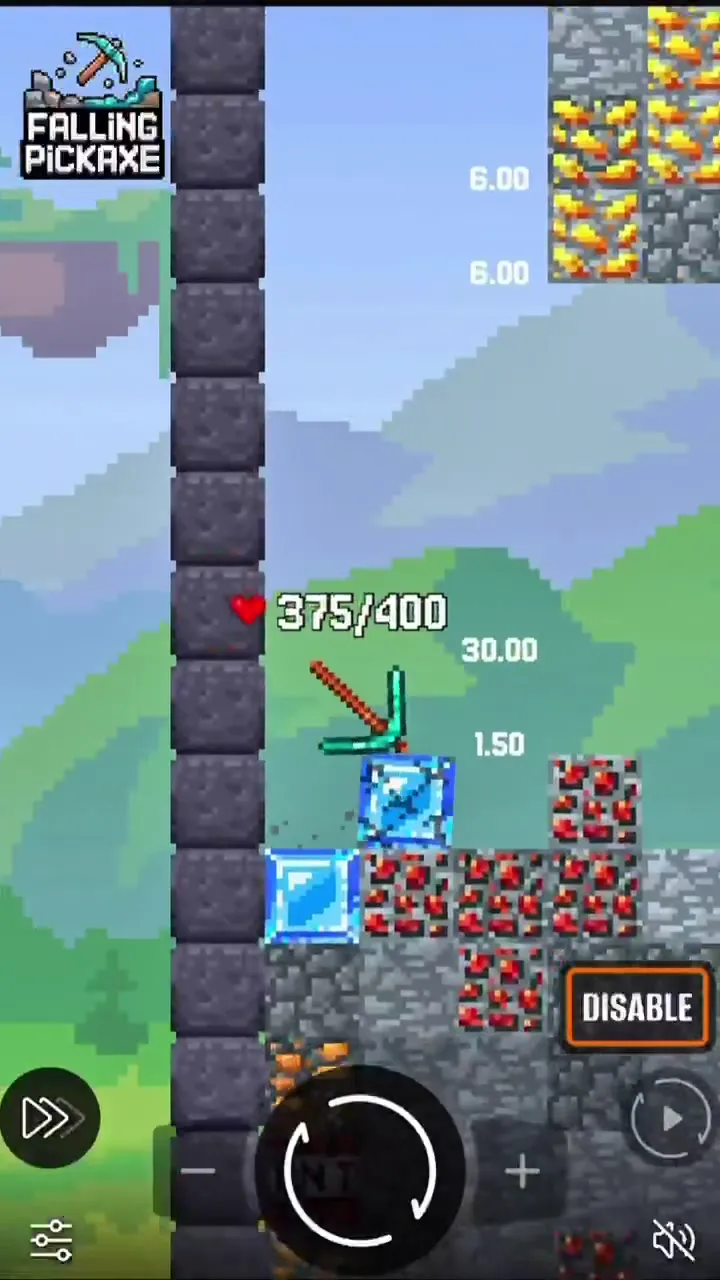
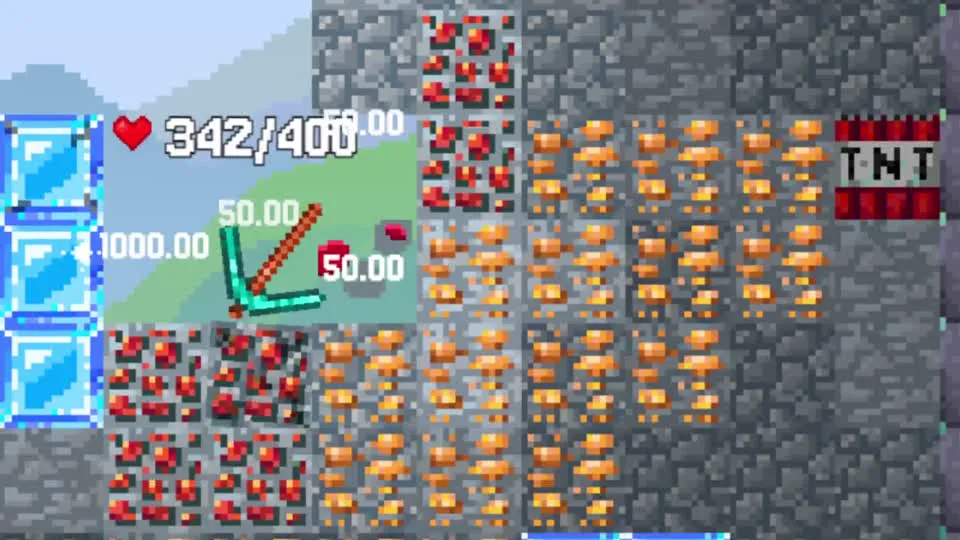
Dirt in Falling Pickaxe does not pay
A long mine made of dirt creates the feeling of an event. By the rules this is HP spent with no reward. Do not confuse the length of the clip with the sum.
A short hit on an emerald can overtake this whole empty shaft. Length is a poor adviser here.
The end of a Falling Pickaxe round at zero HP
A Falling Pickaxe round does not end when you have grown tired of it. It ends when the bar has sat down at zero. Rewards pile up along the way and settle as one sum. There is no separate button to take the multiplier in the middle. If you play crash, this habit breaks here.
You cannot go deeper by a separate command. Depth is a consequence of the hits that remain and of what has come up. If you have pressed the button again in the hope of "one more cell", that is already a new launch with its own reel and its own stake.
The animation can still sprinkle crumbs after zero. The crumbs do not write anything extra onto the payout. Look at the final sum of the round, not at the number of flashes. History, if the operator shows it, helps you match the stake and the credit. It does not hint at the next outcome.
How to read 95% and Low, so that you do not expect compensation from a single zero, is written in RTP Falling Pickaxe. A short round does not realise the percentage. It simply ends.
TNT, the arrow and the crafting table in the game Falling Pickaxe
Along the path three objects can come up, and you do not summon any one of them. TNT, after it is destroyed, removes blocks within a radius. This is a piece of the current descent, not a separate bonus game. The arrow, for a time, makes the pickaxe wider. First up to 1.5. A repeat hit, while the effect is still alive, brings it up to 2, then up to 2.5. A wider corridor means more cells in the same seconds, not a different RTP.
The crafting table fully returns the HP and can raise the level along the ladder of wood, stone, iron, diamond. If the pickaxe is already diamond, it only repairs the stock. The help does not promise that the level will survive the end of the round. The next launch starts from the reel again.
A wooden pickaxe, in a single spin, can reach diamond level if crafting tables come up. The word "can" is doing real work here. It can also fail to come up across ten rounds. This is not a malfunction and it is not a reason to change the stake amount.
There is no price for a bonus-purchase button on the Pixmove card. If such a button exists in the client, read the terms on the spot. The absence of TNT in a short series does not break the rules. The roles of the objects are laid out in more detail in the mechanics; here it is enough to know that they cannot be ordered.
- A cross cancels the fall in this launch.
- The pickaxe goes by itself; the course is not chosen.
- A hit takes 1 HP off the pickaxe and off the block.
- Dirt and stone do not pay.
- The result settles when durability is at zero.
- The ceiling of the card is x160.
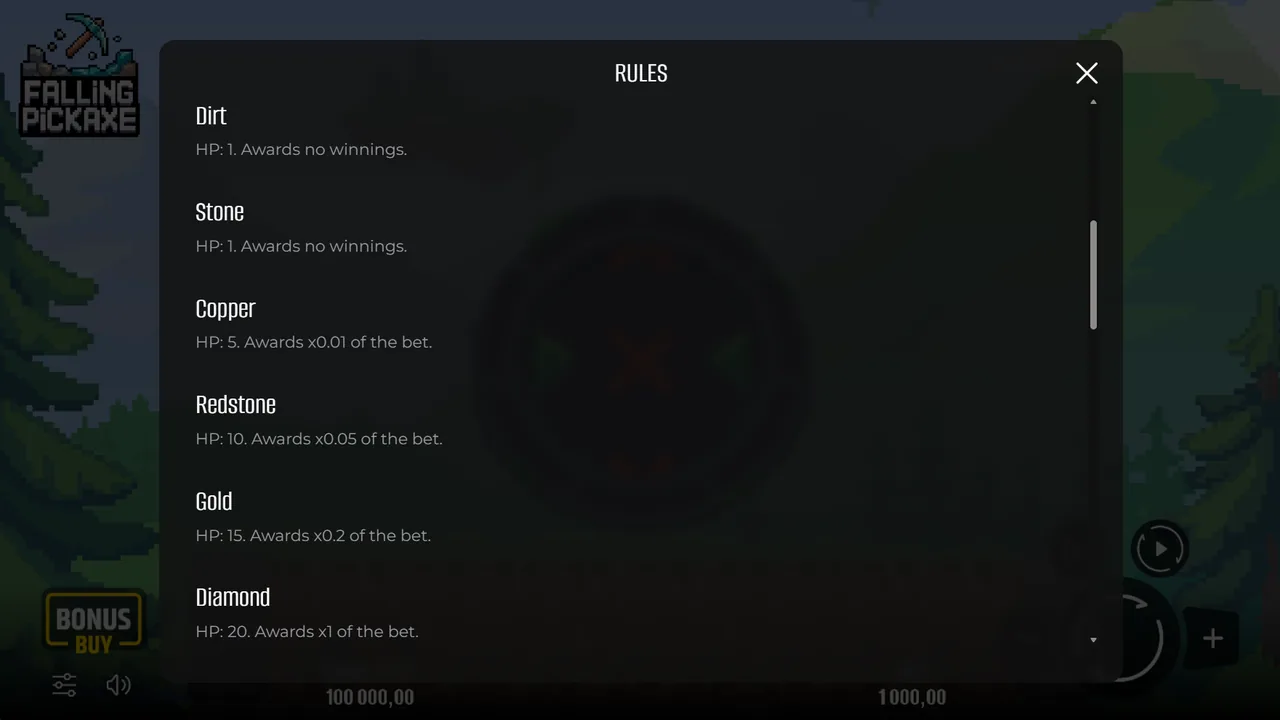
The arrow in Falling Pickaxe does not change the RTP
The arrow increases the coverage, not the return percentage. In the same seconds you simply brush more cells. Among them there can again be dirt.
Do not wait for the arrow as a mandatory bonus of every third spin. It has no timetable.
How to play Falling Pickaxe, not the way crash is played
How to play Falling Pickaxe is useful to understand through what you do not do here. In crash you yourself decide when to take the growing multiplier. Take it early and it stings; take it late and it is often zero. In mines you yourself open the cells and you yourself stop. A mistake on a cell ends the round.
Both of those gestures are absent here. There is no exit point and there is no choice of cell. Minedrop usually holds an upper grid plus a field of blocks. Pixel ore does not unite the paytable. The centre of the Falling Pickaxe frame is a falling pickaxe with no manual course.
That is why "I will learn how to play" does not mean grinding in a timing. It means reading four things. Which pickaxe. How much HP. Which block is on the path. Whether the stock has reached zero. If you name these four, the order of the hands is understood.
I do not put someone else's RTP into the table. Crash and mines have their own cards. They do not make this descent more profitable on paper. Compare who runs the round, and whether it is possible to exit earlier.
| Format | Who runs the round | Early cash-out | What to compare |
|---|---|---|---|
| Falling Pickaxe | The pickaxe goes by itself | Not in the rules | Durability and blocks |
| Crash | The player waits for the multiplier | Usually present | The moment of exit, not the mine |
| Mines | The player opens the cells | The player stops on their own | The choice of a cell, not the fall |
| Minedrop | A different scheme of the round | Does not carry over | Only the picture of the mine |
Cash-out is not provided in Falling Pickaxe
The finger looks for a take button, because other short games have given it one. In the rules of this fall there is no such button.
Waiting for it and getting angry at the interface is pointless. The round will close by itself, at zero durability.
Speed-up when you play Falling Pickaxe
There is a speed-up on the field. At a high speed you can hardly see how to play. The descent collapses into a flash, and it seems that the sum has appeared by itself. The numbers have still come from the blocks. The eye simply has not read them.
The first launches are better without speed-up. Then it is visible that dirt stays silent, while gold leaves a signature. After two slow passes the tempo can be raised. Until then, the speed-up eats the lesson.
The opposite extreme is weak as well. Watching every descent in slow motion and searching for a system. There is no system in the makeup of the shaft. A slow frame is needed so that you learn the blocks and the bar, not so that you calculate the next cross.
Speed-up does not change the card. Instant, 95%, Low and x160 remain. The only thing that changes is whether you have time to understand what the sum has arrived for. On your own money this blindness has already been charged off.
The order of how to play Falling Pickaxe before the stake
If the buttons are still getting mixed up, walk through the same order on a practice account. Demo shows where the stake is, where the HP is and where zero is. It does not create a system and it does not raise the chance of the first paid click. A virtual result is not a withdrawal.
Before a paid launch, check once more the name Falling Pickaxe and the Pixmove signature. An identical pickaxe in another lobby can be a different game. The title of a clip is worth nothing. The screen is worth the check.
The button on the guide opens a partner, not the help of the studio. Set a limit on the sum before the series, not after a plus. Short rounds carry the rhythm across too easily. Short rounds and a limit before the series are set out in responsible play in Falling Pickaxe. The order of the hands is written by the author of the Falling Pickaxe material.
One paragraph about the outline. This text is not a cashier and it is not the operator's licence. The stake is accepted by the site you have moved to. The rules of the fall you can already check against the help inside the client.
- Choose a stake that you see in full.
- Launch the round and read the reel. A cross or a pickaxe.
- If it is a pickaxe, name the type and the starting HP.
- Wait for zero and look at which block gave the number.
- Match the sum of the round, not the number of flashes.
A new Falling Pickaxe round after zero HP
After zero, do not "play it on". The next press is a new reel, a new stake, a new stock. The previous shaft is closed.
The crumbs of the animation after the break do not belong to this new round and do not write anything extra onto the payout.
What to read on the Falling Pickaxe screen during the descent
Until durability has sat down at zero, the Falling Pickaxe screen has only a few honest captions. The type of the pickaxe. The HP that remains. The number on the block that is crumbling right now. Everything else is a flash and a sound. If you are reading these three lines, you are playing. If you are looking only at the bottom of the mine, you are watching a cartoon.
The HP that remains drops on every hit, even on dirt. Do not expect empty rock to "not count". It does count. That is exactly why a long handsome shaft can close sooner than you have waited for an emerald. The stock is not made of rubber.
The number on a block is a share of the current stake, not a separate jackpot. x0.2 on gold at a stake of one thousand and at a stake of one hundred are different sums and one and the same multiplier of the cell. Mixing up the sum on the frame with the multiplier of the round is the most frequent miss after the first plus.
When the bar is already close to zero, new decisions still do not appear. You cannot turn aside, you cannot buy extra hits with a paragraph, you cannot leave the pickaxe "for later". The round plays itself out. Your job in this second is simply not to mix the result up with the next launch button.
If at this moment the hand is already reaching for a repeat click, stop for one descent. Read the sum through to the end. Name the block. Then decide whether the next stake amount is needed. How to play Falling Pickaxe comes down to this pause. Without it, a series of clicks turns into a mush of flashes, and you will not find out what the money was charged for. One such pause at the start saves more than any speeding-up of the animation. Afterwards the tempo can already be raised on purpose, once you already recognise the blocks at a first glance, and not from someone else's clip. Then, yes.
Mistakes when you are learning to play Falling Pickaxe
The first miss is aiming with the cursor. The finger travels over the blocks as if this were mines. In Falling Pickaxe a cell is not chosen. The finger only gets in the way of seeing the bar.
The second is taking depth for a multiplier. You have gone low along the dirt and you are waiting for a large result. The result sits in the type of block. Dirt does not give it, however low the pickaxe has gone.
The third is raising the stake after the crosses, as if the eighth launch had already promised money. It promises a pickaxe, and only after seven crosses. Until then, every cross is an ordinary empty launch.
The fourth is judging by a sped-up flash. Slow one descent down. If you cannot name the block that gave the last figure, you are not playing yet. You are watching a cartoon. When you can name it, the order of the hands is assembled, and the stake amount is already your choice, not a confusion of the interface.
The chain of how to play Falling Pickaxe
The practical sense of the Falling Pickaxe rules fits into a single chain. The stake amount, the reel, the presence of a pickaxe, the fall, zero HP, the sum. Everything that does not enter this chain is either the shell of the operator, or someone else's game with a similar picture.
If a cross has landed several times, this is not a signal to raise the stake. The next reel is not obliged to compensate for the series. The exception is one, and it is a narrow one: the eighth launch after seven crosses is obliged to show a pickaxe, not a win.
Before a paid click it is useful to name aloud the type of the pickaxe and its starting HP. If there is nothing to name, the screen has not been read yet. Wood 100, stone 150, iron 200, diamond 400. These numbers live in the help, not in the advertising.
The result of the round is checked against a single figure of the credit. Bright cells along the way can be worth little, while a quiet diamond can be worth noticeably more. The depth of the mine does not by itself turn into that figure.
Frequently asked questions about Falling Pickaxe
Where do you start a Falling Pickaxe round?
Choose a stake and press launch. From there on, the reel decides.
Can you control the pickaxe?
No. You set the stake amount. The path downward is set by the round.
What does the eighth launch after seven crosses give?
One of the four pickaxes. Not a win and not an emerald.
When is the result credited?
When durability reaches zero. You cannot take it midway.
Where can you see the same thing without money?
In the Falling Pickaxe demo, if the site has opened a practice account.
The course of one round is described above. What follows is a partner launch, if you decide to open the game.