
Pixmove, June 2026
Falling Pickaxe review of the game with a falling pickaxe
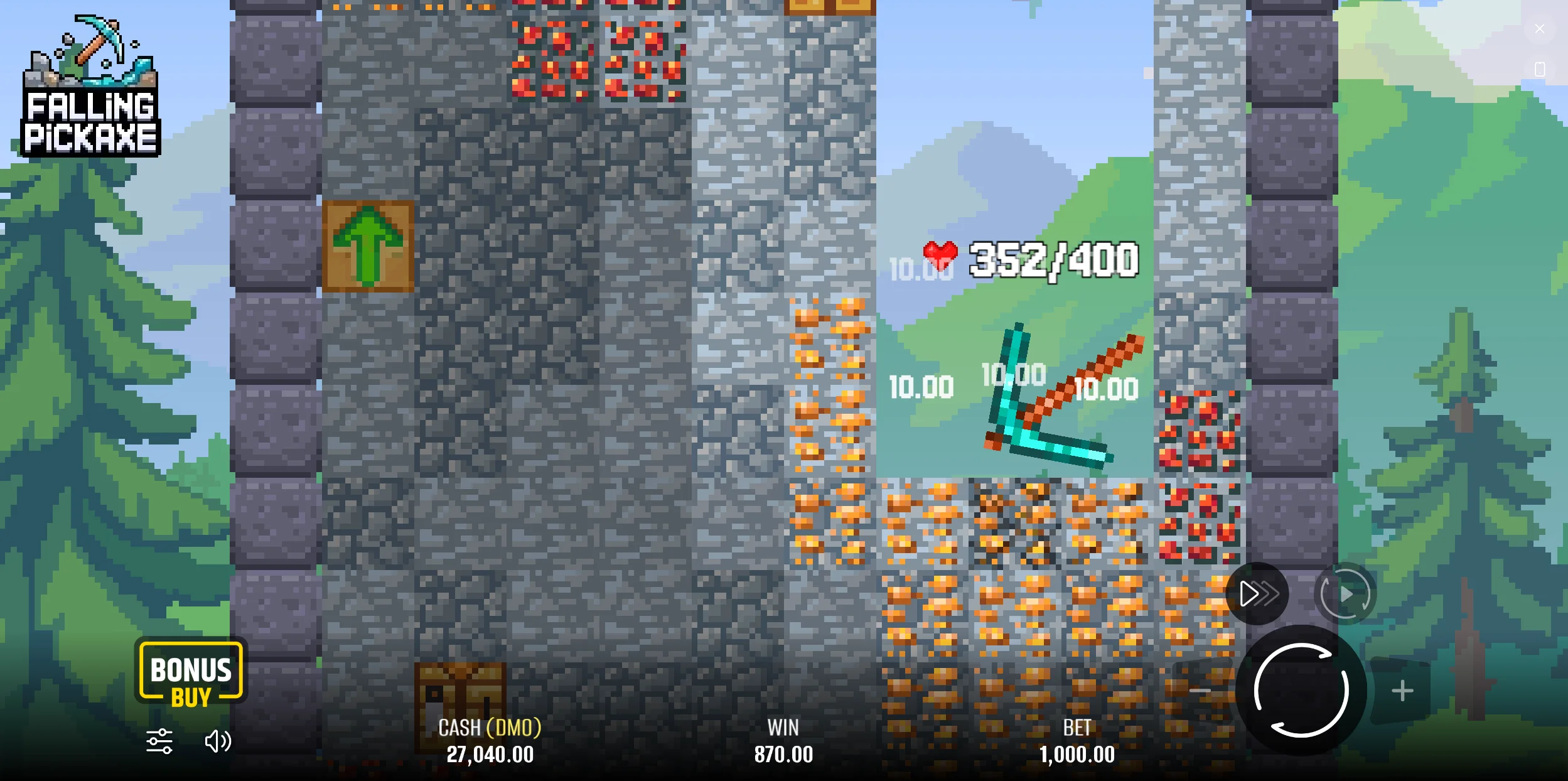
Falling Pickaxe from Pixmove drops a pickaxe into a mine with blocks. While durability remains, the round is still alive. The card shows RTP 95% and a ceiling of x160. Beyond that, only what is visible in the rules.
Contents
- Falling Pickaxe starts with the reel
- The Falling Pickaxe card: RTP 95% and x160
- Falling Pickaxe pickaxes and the HP reserve
- Falling Pickaxe blocks and payouts per hit
- TNT, the arrow and the crafting table in Falling Pickaxe
- Seven crosses in Falling Pickaxe and the eighth launch
- Falling Pickaxe versus crash, mines and Minedrop
- Who Falling Pickaxe suits
- Animation speed-up in Falling Pickaxe
- Checking Falling Pickaxe before a stake
Falling Pickaxe starts with the reel
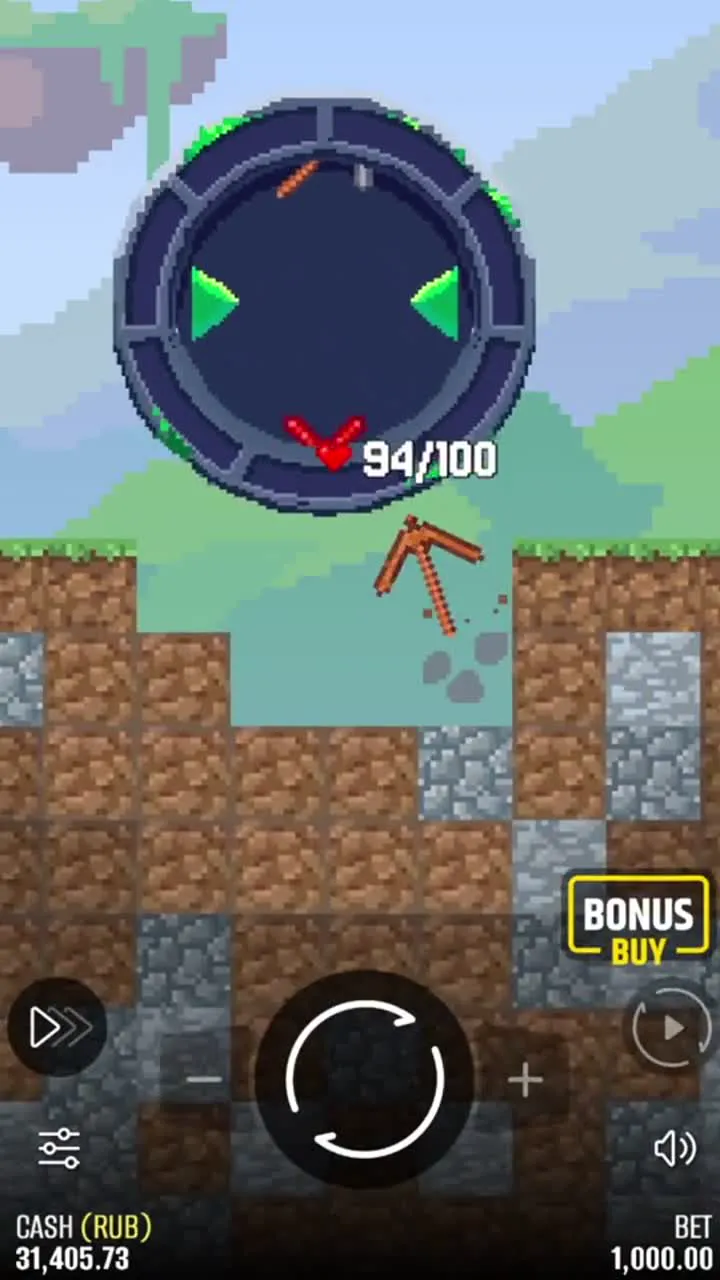
You set an amount and press launch. At that point your work in Falling Pickaxe is almost over. The game does not assemble a line of symbols and does not wait for you to open a cell. First, a single reel plays out. On it there is either a cross or a pickaxe.
A cross means an empty launch. There is no pickaxe, no fall, and the mine does not even start. A pickaxe means the tool has already been chosen and goes down by itself. Wood, stone, iron or diamond. You do not make that choice with the cursor.
After that the frame looks like a tube into which a weight has been dropped. The tool hits everything that stands in its path, and for each hit it gives up one unit of durability. The amount accumulates along the way. There is no separate button to take it off in the middle. The credit arrives when the scale reaches zero.
If you are used to deciding when to leave a round, that lever is not here. Either a cross and silence, or a full descent until breakage. The order of the buttons and the stake are explained on the page how to play Falling Pickaxe.

A cross in Falling Pickaxe closes the launch
An empty reel does not record a debt to you and does not promise that the next descent will be fatter. A run of crosses is irritating, but the rules do not include compensation for a bad mood.
The only narrow exception is seven crosses in a row. The eighth launch is obliged to show a pickaxe. Not a plus, not a diamond and not an emerald. Simply a tool.
The Falling Pickaxe card: RTP 95% and x160
The Falling Pickaxe card is short. Class Instant. RTP 95%. Volatility Low. Maximum x160. The release month is June 2026, and the card does not set a day inside the month. I will not invent a day from someone else's catalogue.
95% is easy to read as a promise to return almost everything over an evening. That is not the case. The percentage is calculated over a very long distance of all stakes, not over your twenty clicks. Low speaks of a more even spread than in games where nothing happens for a long time and then a huge multiplier rarely arrives. More even does not mean that you are in profit.
x160 closes one round relative to the stake. A pretty deep mine on the screen does not raise that ceiling. If the open panel shows a different number, trust the panel, not the paragraph. How not to confuse the percentage with the frequency of successful descents is written in RTP Falling Pickaxe.
The minimum stake, the maximum stake and the price of a separate purchase are empty on the card that was used. I do not enter them in the table below. The button on this site leads to a partner, not to the studio page.
| Field | Falling Pickaxe |
|---|---|
| Studio | Pixmove |
| Class | Instant |
| RTP | 95% |
| Volatility | Low |
| Round ceiling | x160 |
| Release | June 2026, day not stated |
95% in Falling Pickaxe does not promise an evening
A hundred fast descents is still too short for 95% to "come true". A session can end noticeably above or noticeably below the card. That is not evidence that the percentage is fake.
Raising the stake size so that the percentage catches up with you sooner is useless. The card does not watch your balance and does not compensate for a run of crosses.
Falling Pickaxe pickaxes and the HP reserve
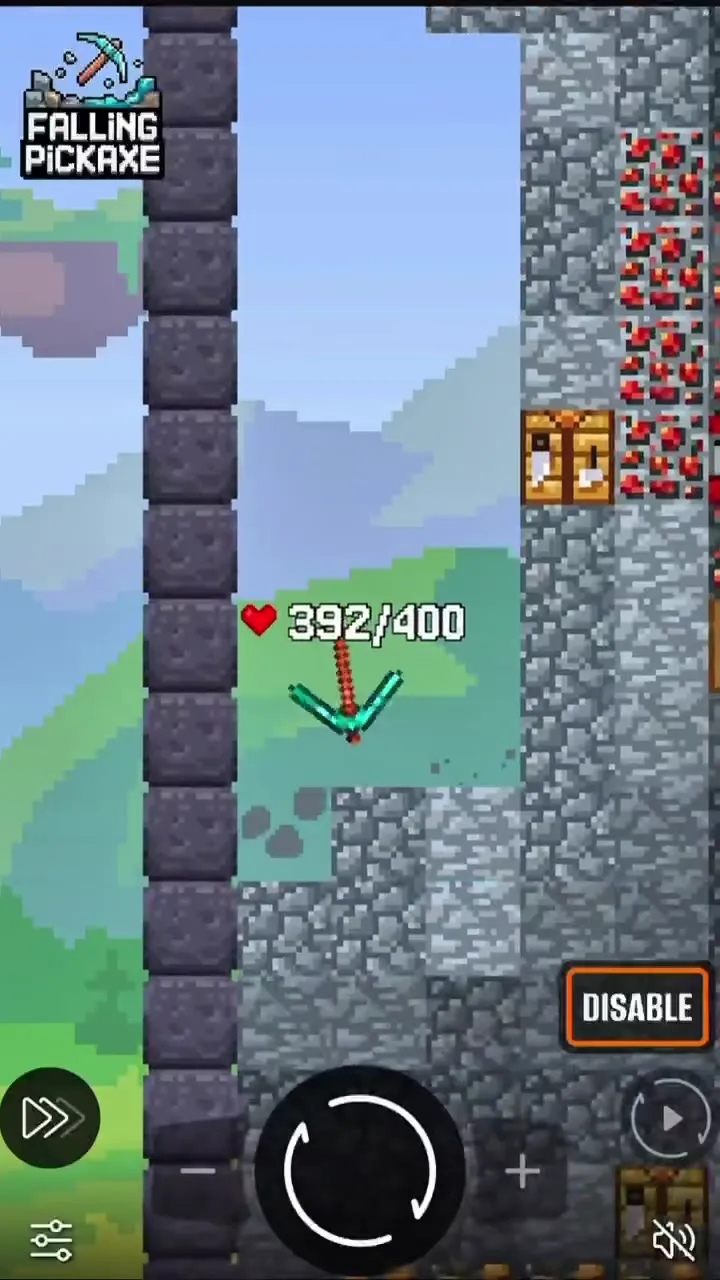
The help inside the client sets the starting reserve of hits. Wood starts at 100 HP, stone at 150, iron at 200, diamond at 400. Each hit on a block removes 1 HP from both the pickaxe and the block. This is not a character's health. This is the length of the current fall.
More HP means more collisions until the tool breaks. This is not a lottery for good ore. A diamond pickaxe can travel farther than a wooden one and still collect a modest amount if dirt and stone lie under it. A wooden one can run into an emerald almost immediately and close the round more handsomely than a long empty mine.
The reserve burns out together with the round. Zero closes the descent, and the next launch issues a tool anew. An early break does not create a debt the game owes you. A run of identical wooden starts does not switch anything on either: the reel does not keep a fairness log.
On the frames this is visible on the counter. A nearly full diamond reserve and wood that has already been eaten into are different lengths of the same trip. Objects along the path that can repair the reserve are explained in Falling Pickaxe mechanics.
| Pickaxe | Starting HP |
|---|---|
| Wooden | 100 |
| Stone | 150 |
| Iron | 200 |
| Diamond | 400 |
The diamond pickaxe in Falling Pickaxe does not choose the ore
It is easy to decide that 400 HP is by itself worth more than 100. Only the potential length is worth more. The composition of the mine is decided separately.
If wood has come up several times in a row, that is not a signal to raise the stake. The next reel is not obliged to compensate for the run.
Falling Pickaxe blocks and payouts per hit
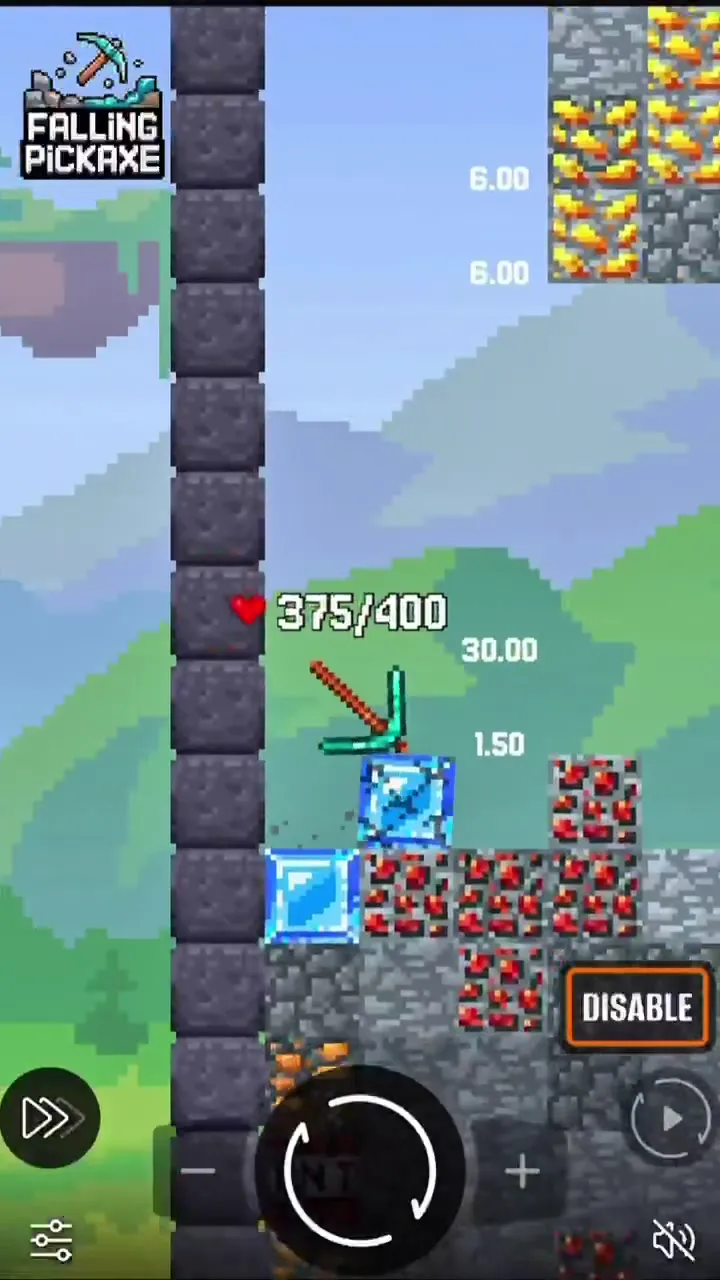
Dirt and stone in the help last 1 HP and do not pay. They look like a mine, but in money terms they are an empty spend of durability. Copper holds for 5 HP and gives x0.01 of the stake. Redstone is 10 HP and x0.05. Gold is 15 HP and x0.2. Diamond is 20 HP and x1. Emerald is 30 HP and x5.
From this comes a simple trick of the eye. Two descents with the same number of hits can be worth different amounts. One punched through dirt. The other caught gold and emerald. Counting cells downward as a multiplier is pointless. Look at the label on the block, not at how low the pickaxe has travelled.
x5 on an emerald is the reward for a destroyed block relative to the stake. x160 is the ceiling of the whole round on the card. These are different shelves. A large figure on a frame without the stake size does not prove a multiplier.
The table below is taken from the rules screens, not from an advertising banner. If the help in your build diverges from it, the help is correct. Someone else's video with similar ore does not carry its table over here.
| Block | HP | Reward from the stake |
|---|---|---|
| Dirt and stone | 1 | none |
| Copper | 5 | x0,01 |
| Redstone | 10 | x0,05 |
| Gold | 15 | x0,2 |
| Diamond | 20 | x1 |
| Emerald | 30 | x5 |
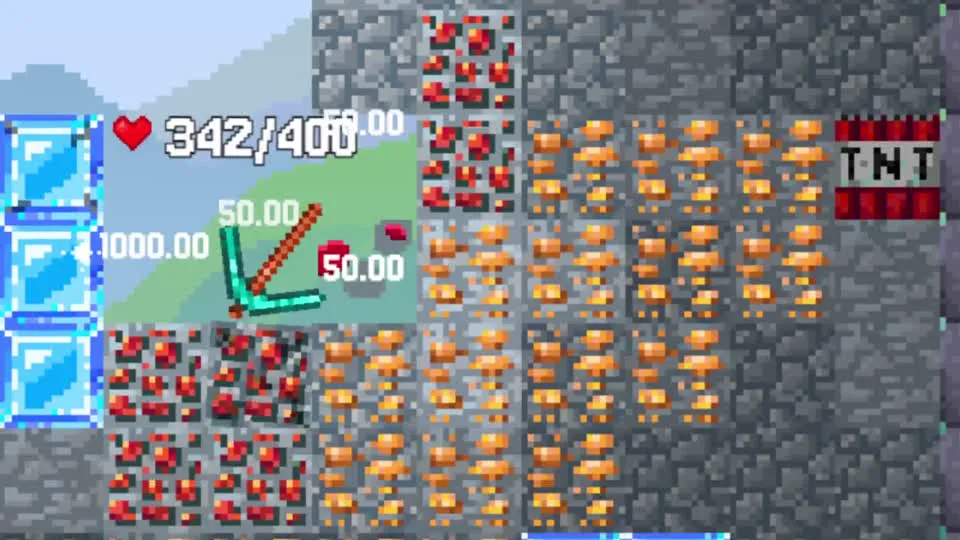
Depth in Falling Pickaxe does not equal the multiplier
Lower down the shaft there are often more events. That is still not a multiplier. You can travel deep through empty rock and close the round almost at zero.
And the other way around. A short contact with an emerald on a wooden reserve can be worth more than a long empty tube.
TNT, the arrow and the crafting table in Falling Pickaxe
TNT, after it is destroyed, removes blocks within a radius. This is a piece of the current mine, not a separate bonus game with a new field. The explosion belongs to the descent that is already underway. There is no separate button to call in a charge.
The arrow temporarily makes the pickaxe wider. First up to 1.5 times the size. If during the effect you hit an arrow again, up to 2, then up to 2.5. A wider corridor means more cells in the same seconds. RTP does not change because of this. What changes is how much rock the tool will catch while the effect is alive.
The crafting table fully restores HP and raises the level up the ladder of wood, stone, iron, diamond. If the pickaxe is already diamond, the crafting table only repairs the reserve. The help does not promise that the level will survive the end of the round. The next launch starts from the reel again.
It is exactly these three objects that explain the phrase that a wooden pickaxe can reach diamond level in a single spin. The word "can" is the main point here. They may be absent for a whole short session, and that is not a fault.
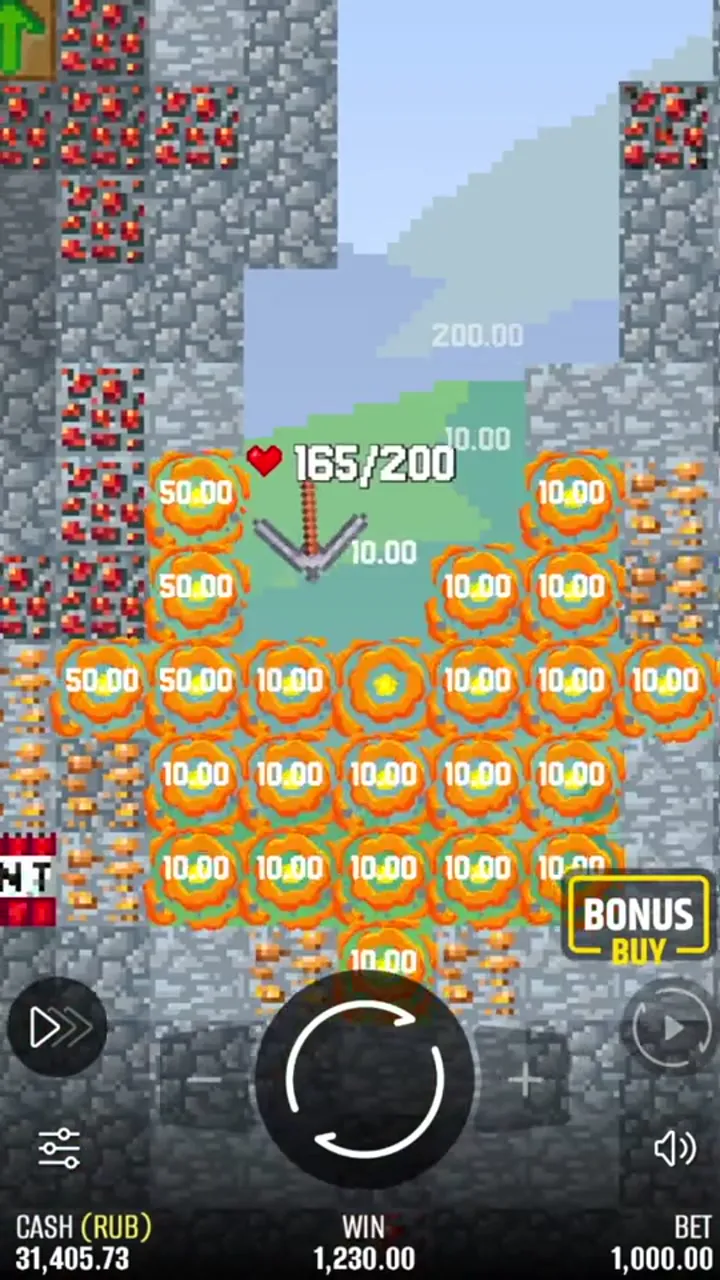
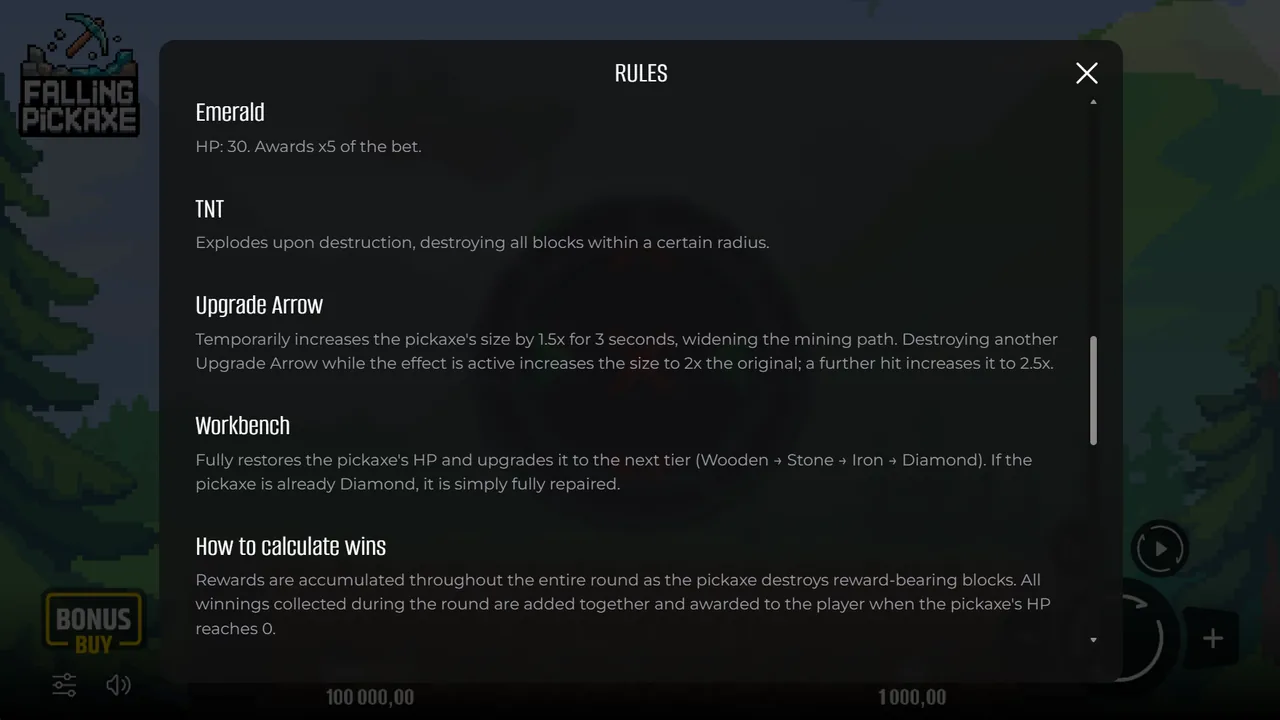
TNT and the crafting table in Falling Pickaxe cannot be bought
The Pixmove card has no price for a bonus-purchase button. If such a button is nevertheless present in the client, read its terms on the spot, not in this paragraph.
You cannot call a crafting table or TNT by command. Absence across five rounds does not break the rules.
Seven crosses in Falling Pickaxe and the eighth launch
The interface rules are narrow. Seven crosses in a row are closed by an eighth launch on which a pickaxe is guaranteed. This is not a higher-payout mode and not a promise of an emerald. The guarantee concerns only the appearance of the tool.
Until the seventh cross, every empty reel is an ordinary lost launch. Do not keep a tally of "they owe me" and do not raise the stake on the sixth as if the game is already obliged to pay out. It is obliged only on the eighth, and only to a pickaxe.
The rule does not assign which of the four pickaxes will come up on that launch. Wood at 100 HP may arrive. Diamond at 400 may arrive. The composition of the blocks under it is still a separate draw.
If in your build the help phrases the run differently, the help is correct. This paragraph describes the rules screen we read, not every client in the world.
Do not confuse this guarantee with buying a bonus. You do not pay a separate price for the eighth launch and you do not choose which pickaxe will arrive. Simply, after seven crosses, the next reel is not allowed to show a cross again. Everything below the pickaxe is still a random mine shaft.
Falling Pickaxe versus crash, mines and Minedrop
Comparing Falling Pickaxe with the reels of large studios is useless. There the round is different, the bonuses are different and the length of the round is different. Short formats are closer, and even they are built differently.
In crash you yourself decide when to take the growing multiplier. Miss the timing and the round often burns out. In mines you yourself open cells and you yourself stop. A wrong cell ends the round. In Minedrop there is usually a top grid plus a field of blocks. Shared pixel ore does not unite the payout table.
Here the centre of the frame is a falling pickaxe with no manual course. You do not choose the moment of exit and you do not choose a cell. The tension is different. Whether the reserve will last until a valuable block, not whether you will manage to press in time.
I do not place a foreign RTP in the table. Each version has its own, and neat columns of invented percentages only lie. A matching picture of a mine does not transfer the mathematics.
| Format | Who runs the round | Early cash-out | What to compare |
|---|---|---|---|
| Falling Pickaxe | The pickaxe goes by itself | Not in the rules | Durability and blocks |
| Crash | The player waits for the multiplier | Usually present | The exit moment, not the mine |
| Mines | The player opens cells | The player stops on their own | Cell choice, not the fall |
| Minedrop | A different round scheme | Does not carry over | Only the picture of the mine |
A foreign RTP is not placed next to Falling Pickaxe
If crash or mines on your site has a different percentage, that is their card. It does not make Falling Pickaxe better or worse on paper.
Look at who runs the round and whether there is an early cash-out. That is an honest comparison. A foreign percentage is not.
Who Falling Pickaxe suits
Falling Pickaxe reads well on a phone. One pickaxe, a vertical field, an HP scale, numbers directly on the ore. The round is short. You do not have to remember a bonus map across ten screens.
If you need to decide yourself when to exit, take crash. If you like opening cells and stopping in time, take mines. If you want long bonus scenarios and a rare very high ceiling, this descent will feel straightforward. x160 is a property of the card, not a typo in the text.
Pixel blocks by themselves say nothing about the odds. A familiar diamond does not make the game a mod of someone else's sandbox. Check the structure of the round and the Pixmove label, not only the colour of the ore.
A beginner finds it easier to start with a trial balance and one slow descent, without speeding up the animation. At high speed the fall looks like a flash, and it seems as if the multiplier appeared by itself.
An experienced player has nothing to "beat" here either. There is no exit point that you train for weeks, as in crash. There is no map of cells that you learn to abandon, as in mines. There is only reading the screen. Which pickaxe came up, how much HP is left, which block stands in the path, whether the reserve has reached zero. If you can name these four things out loud, the game is understood. If not, a pretty frame is getting ahead of you.
Similar ore is not Falling Pickaxe
Cubes, a pickaxe and blue ore are recognised at once. That is where the resemblance to someone else's sandbox ends. There you walk and dig yourself. Here the tool falls down a ready-made shaft of a single round, and the stake is already placed.
If a video shows a character's step and an inventory on the belt, that is not Falling Pickaxe. If the pickaxe falls by itself and the round ends by durability, check the name against the Pixmove card, not against the video title.
A video title costs the feed's author nothing. Two similar frames are still not a reason to open a wallet. First the help, then the stake size. The colour of a diamond does not by itself justify a stake. This is a different game.
Animation speed-up in Falling Pickaxe
On the Falling Pickaxe field there is a speed-up. At high speed the descent collapses into a single flash. It seems as if the result appeared by itself, without blocks. That is a trick of the picture. The numbers still come from specific cells; the eye simply does not have time to read them.
The first launches are better watched at a normal pace. Then it is visible that dirt and stone only eat HP, while gold and emerald leave a label. After two or three slow descents the speed-up no longer hides the mechanics. Before that, it does hide them.
The same goes for a trial balance. A fast run of demos creates a feeling of rhythm, but it does not replace one attentive pass down to zero. If you cannot name which block produced the last figure, the screen has not been read yet.
The speed-up does not change the card. RTP 95%, Low and x160 stay in place. What changes is only whether you have time to understand what the amount arrived for. On real money that inattention has already been written off.
There is also the opposite habit. Watching every descent in slow motion and looking for a system in it. There is none there. A slow frame is needed once or twice, to learn dirt, gold, emerald, TNT and the crafting table. After that the pace can be raised, but the stake size does not become smarter because of it.
Checking Falling Pickaxe before a stake
First learn the screen. Then open the help and check the four fields of the card. Instant, 95%, Low, x160. If the buttons are still confusing, go through how to play Falling Pickaxe from the stake to zero HP.
A trial balance, if the site opens one, shows the same breakage of the tool without a payout. Virtual chips are not a withdrawal. The differences are collected in the Falling Pickaxe demo. The card does not provide a separate file; this is the page Falling Pickaxe download.
The button on the site is a partner button. It is not a Pixmove address and it does not confirm that an official build has opened. Set a limit on amount and time before a series of clicks. Amount and time before a series are better closed off using the page responsible play in Falling Pickaxe. The breakdown is signed by the author of the Falling Pickaxe material.
One paragraph about the outline, and that is enough. This domain is not a cashier and not an operator licence. The stake is accepted by the site you moved to. Check the game card with Pixmove separately from the button.
- Check the name Falling Pickaxe and the Pixmove label.
- Find the stake, the HP scale and the rules button.
- Wait for zero durability in one descent and see which block produced the number.
- Fix the amount and the time that it is acceptable to lose.
- A cross on the reel cancels the fall in this launch.
- The pickaxe falls by itself; the cursor does not set the trajectory.
- One hit removes 1 HP from both the pickaxe and the block.
- Dirt and stone spend durability; they do not pay.
- The card ceiling is x160; the emerald reward is x5 per block.
The Falling Pickaxe demo does not cash out chips
The demo is needed in order to see the breakage, the numbers on the ore and the moment of zero. It is not needed in order to "check whether it pays today".
Ten successful trial descents do not measure RTP 95%. They show only whether the screen is readable on your phone.
Frequently asked questions about Falling Pickaxe
Who made Falling Pickaxe?
Pixmove studio. That is a line on the card, not someone's credit under a video.
What percentage is on the card?
95%. That is a calculation over the long distance of all stakes, not a forecast of your evening.
Up to what multiplier does one round go?
Up to x160 of the stake. A deep shot of the mine does not cancel that ceiling.
Can you steer the pickaxe yourself?
No. You choose the stake size and the launch. The path downward is set by the round.
Where are the buttons and blocks explained?
Buttons and the stake are on the page how to play Falling Pickaxe. Blocks, TNT and the crafting table are in Falling Pickaxe mechanics.