
Practice mode
Falling Pickaxe demo on a virtual account with no payout
The Falling Pickaxe demo shows the same pickaxe descent as play for money. The virtual account is not withdrawn. First look at the field. Only then decide about the stake.
Contents
- The Falling Pickaxe demo repeats the descent without a stake
- Where to open the Falling Pickaxe demo
- Virtual rubles in the Falling Pickaxe demo
- What to watch in the Falling Pickaxe demo before money
- The pickaxe in the Falling Pickaxe demo breaks the same way
- Blocks and payouts in the Falling Pickaxe demo
- TNT and the crafting table in the Falling Pickaxe demo
- The Falling Pickaxe demo against crash and mines
- What the Falling Pickaxe demo cannot do
- Registration and the Falling Pickaxe demo
- When to close the Falling Pickaxe demo
- How to read the Falling Pickaxe demo without haste
The Falling Pickaxe demo repeats the descent without a stake
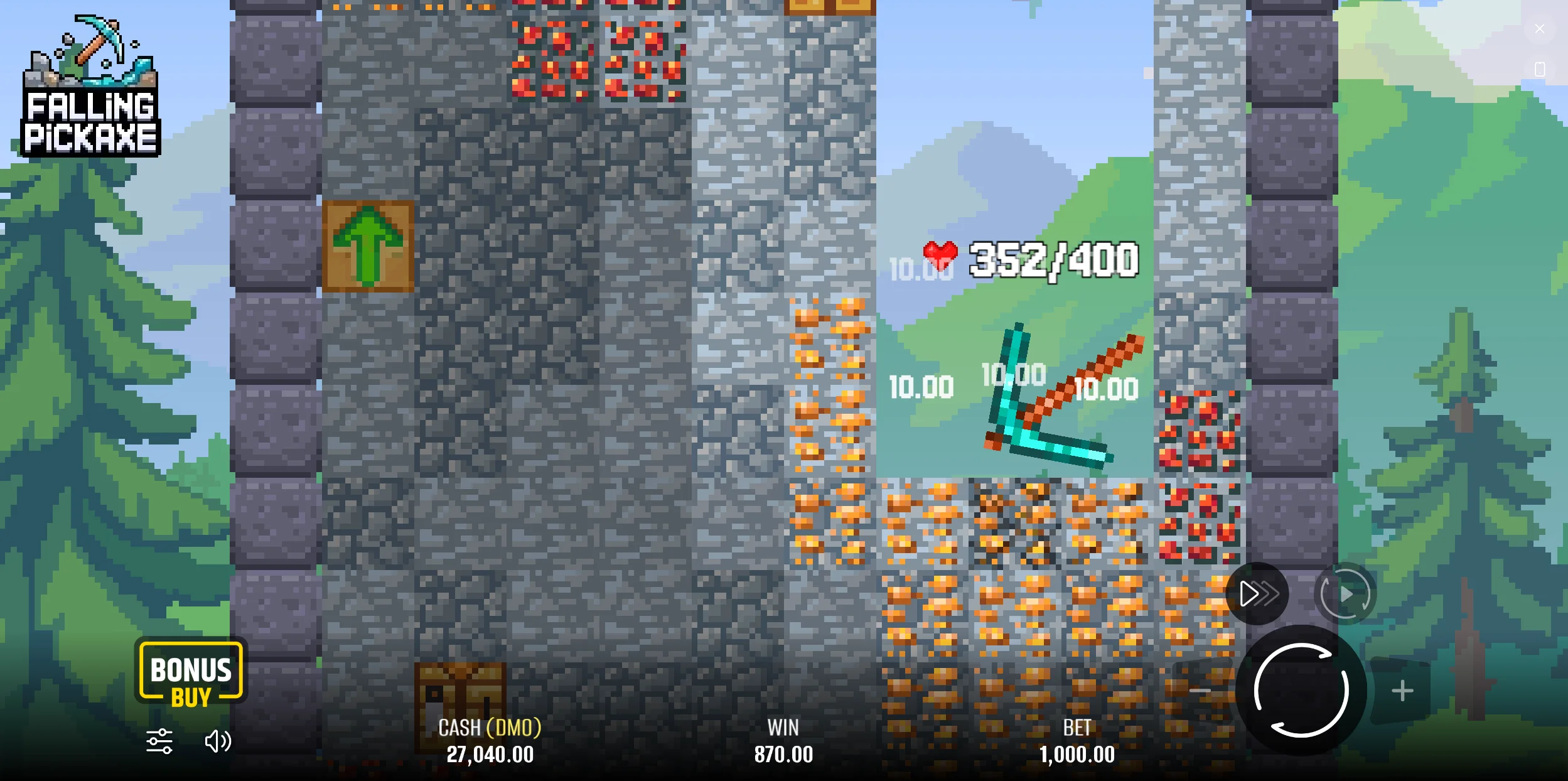
You open the demo and see the same mine. A reel, a pickaxe, blocks, an HP bar. Falling Pickaxe does not substitute the rules in the practice window and does not draw a separate “kind” table for beginners. Only one thing changes. A click costs nothing, and the result cannot be taken away.
A clip in the feed almost always shows a lucky stretch. The demo shows the ordinary rhythm, including the cross and dirt that only eats durability. If you judge the game by one bright frame, the practice account breaks that quickly. And it does so rightly.
The word demo in the interface and the Russian word demo in the text are about one mode. This is not a second game and not a cut-down copy. The pickaxe falls by itself. The cursor does not set the trajectory. Zero HP closes the descent the same way as on money.
The overall picture of a round is collected in the Falling Pickaxe review. Here the conversation is already about the practice launch. What to watch, what the demo does not prove, and when it is time to close the practice account.
Where to open the Falling Pickaxe demo
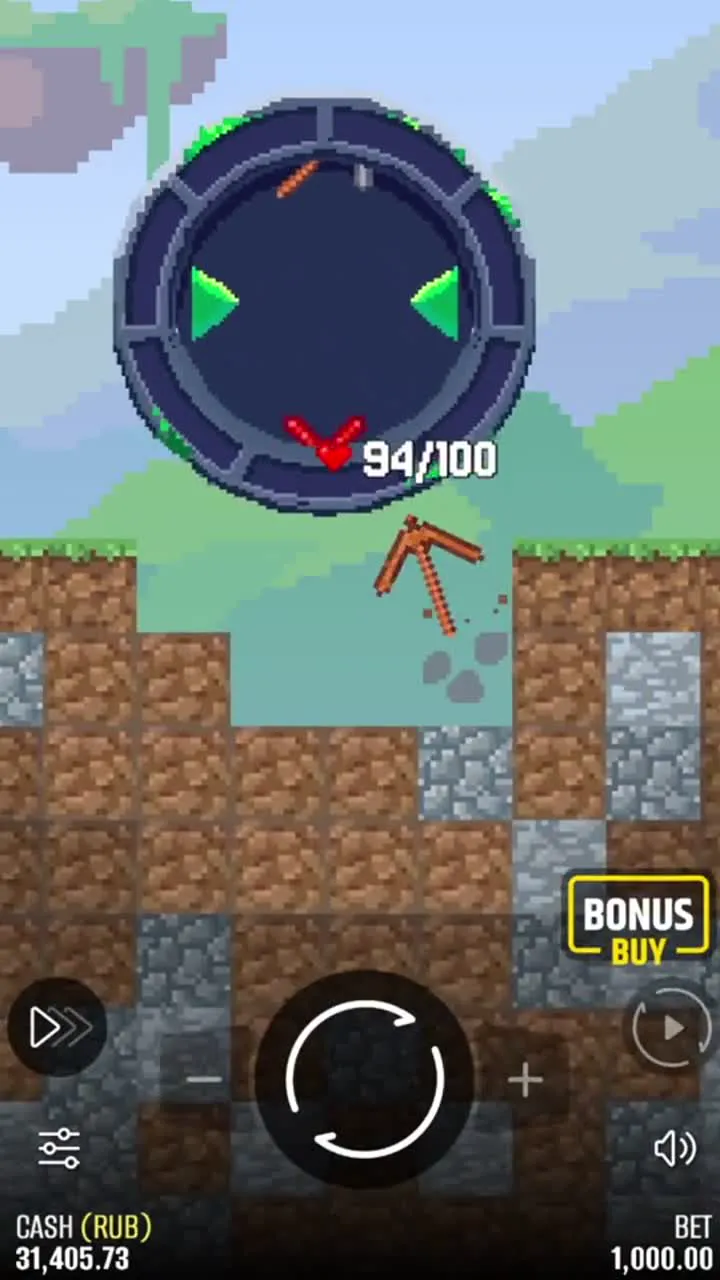
The green “Play” button on this guide does not launch the demo. It leads to the partner, to the place where a stake may already be standing. Look for the practice window inside the client. Sometimes it is labeled demo, sometimes the Russian demo, sometimes it is simply play on virtual chips before a deposit.
Guest entry depends on the platform, not on the name Falling Pickaxe. In some places it is enough to open the lobby. In others they ask for an account, but not a card. Payment details are not needed for a practice round. If the form immediately asks for a deposit, you are already not in the demo.
The Pixmove card may give out its own practice launch. The operator may give out its own. These are not two different maths if the same pickaxe and the same help are on the screen. The absence of a demo at one operator does not mean that the studio removed the game.
Someone else's file from an ad does not close the gap. If the window does not load, first refresh the page and try another browser. The card does not describe a separate application; the page about that is Falling Pickaxe download.
An empty frame in the Falling Pickaxe demo
A black frame is more often tied to the network, a blocker, or data saving on the phone. Reinstalling an unknown package does not cure this.
The checkpoint is the name Falling Pickaxe and the Pixmove label on the screen. A match in the color of the blocks does not confirm the game.
Virtual rubles in the Falling Pickaxe demo
On the practice balance there may stand a ruble sign, a euro sign, or simply credits. This is a way to show a figure, not a right of withdrawal. A demo in rubles and a stake in rubles are different modes. Confusion here is the most expensive.
The starting size of the virtual balance is not fixed in the help of the open version. If one amount is on the screen and another amount is in someone else's review, your build is the correct one. I do not assign this figure.
Virtual chips are not converted. You cannot “play the demo up to a large amount and then withdraw it”. The amount lives inside the window and dies together with the session. A rehearsal of a withdrawal does not come of this.
A rehearsal of reading, on the other hand, does come of it. You see how the stake in practice mode scales the numbers on the blocks, and you understand that x0.01 of copper and x5 of emerald are shares of this stake, and not gifts on top of it.
What to watch in the Falling Pickaxe demo before money
First, the shape of the mine and the pixel blocks. Second, the durability counter, which decreases from hits. Third, the numbers right beside the ore. Fourth, the moment when the pickaxe breaks and the round closes. If a clip from the feed does not match these four points, it may be a different game with a similar pickaxe.
The title of a clip costs the author of the feed nothing. The demo is precisely for checking. Pause mentally after one slow descent and name the block that gave the last figure. If you cannot name it, the screen has not been read yet, and it is too early to turn acceleration on.
TNT, the arrow, and the crafting table may not turn up in the first launches. Their absence does not disprove a short demo session. These objects are not called up by a button. The details of the cells lie in the mechanics of Falling Pickaxe.
Open the help without closing the client. The second screen of the rules is precisely about the payouts of blocks. If the table below diverges from your help, the help is the correct one.
A slow descent in the Falling Pickaxe demo
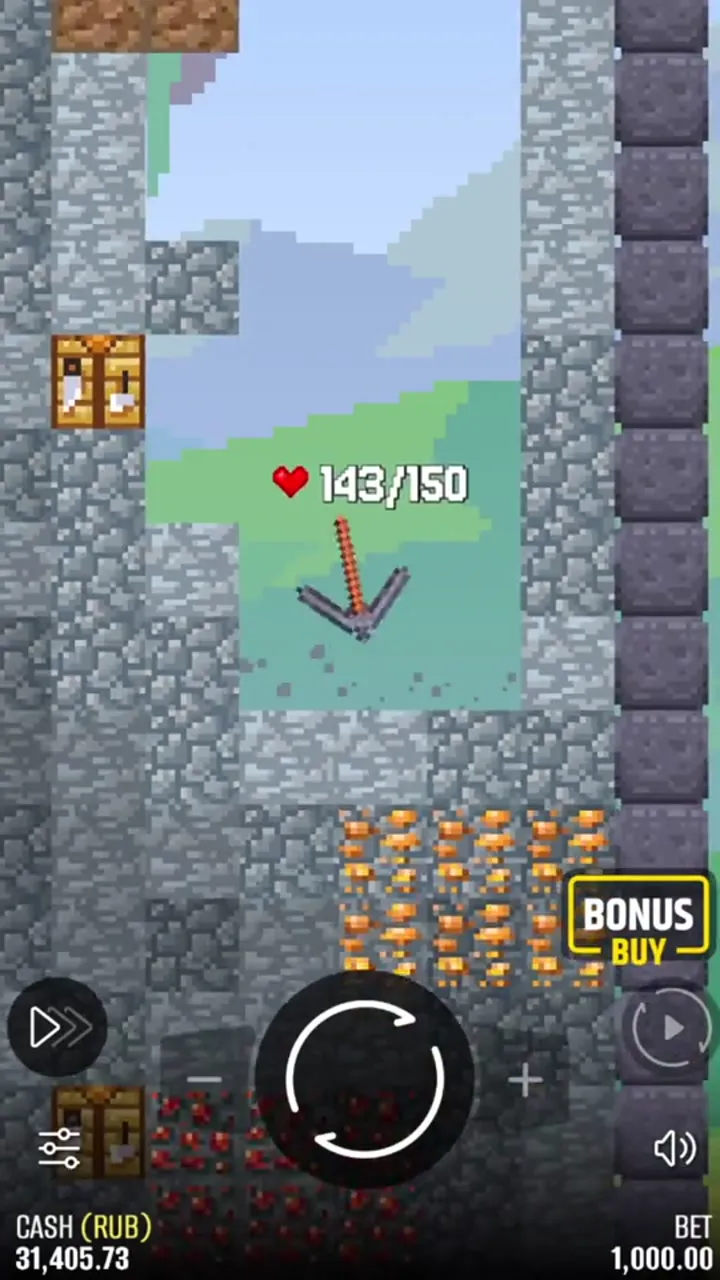
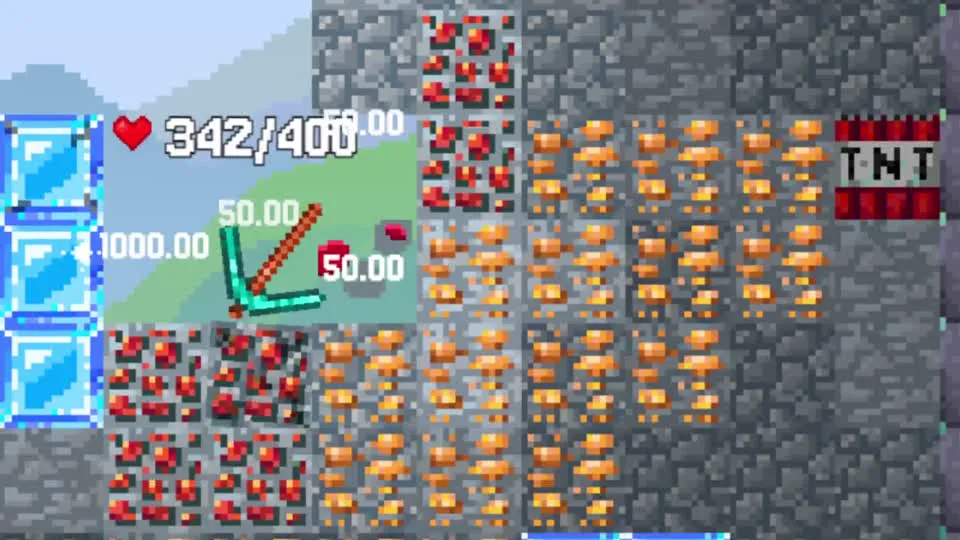
On acceleration the demo turns into a spot of light. It seems that the result arose by itself. At ordinary speed it is visible that dirt stays silent, while gold leaves a number.
Two slow passes are enough to learn the bar. After that the pace can be raised already on purpose.
The pickaxe in the Falling Pickaxe demo breaks the same way
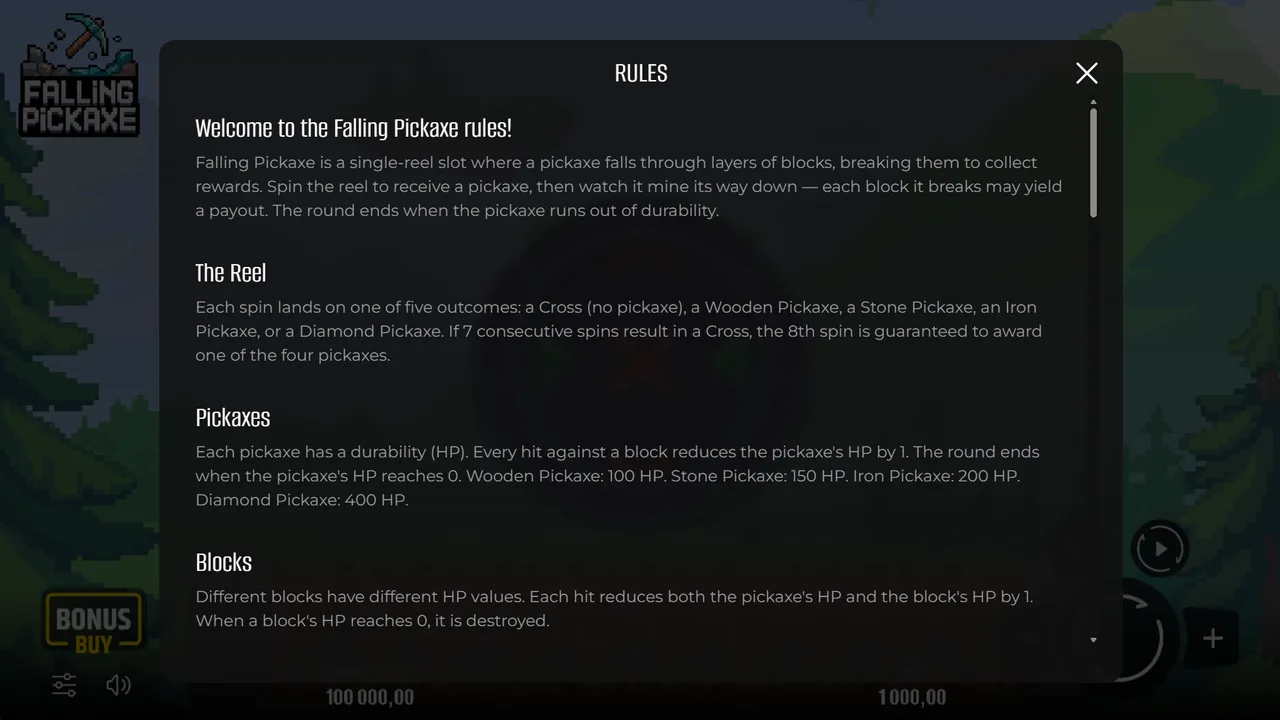
Practice mode does not issue an endless diamond. The reel still shows a cross or one of the four pickaxes. Wood starts with 100 HP, stone with 150, iron with 200, diamond with 400. A hit removes 1 both from the pickaxe and from the block.
A larger reserve in the demo means only a longer fall. It does not choose the ore under your feet. You can receive a diamond at 400 and collect scraps if the shaft is packed with dirt. You can break wood almost at once against an emerald and close the practice round more handsomely.
The reserve does not move across into the next practice launch. Zero closes the descent. A new click issues the tool over again. A series of wooden pickaxes in the demo “owes” nothing. The reel does not keep a fairness journal either on chips or on money.
Seven crosses in a row are closed here too by an eighth launch with a guaranteed pickaxe. The guarantee is about the tool, not about a plus. If the wording in the help of your build is different, that wording is the correct one. The order of the buttons is set out on the page how to play Falling Pickaxe.
| Pickaxe | Starting HP |
|---|---|
| Wooden | 100 |
| Stone | 150 |
| Iron | 200 |
| Diamond | 400 |
A plus in the Falling Pickaxe demo does not raise the chance
Five successful demo descents do not raise the chance of the first paid one. Five empty ones do not break the model. This is a tiny sample.
RTP 95% is not measured on a series like that. The percentage lives on a distance that an evening does not cover. How to read it is written in RTP Falling Pickaxe.
Blocks and payouts in the Falling Pickaxe demo
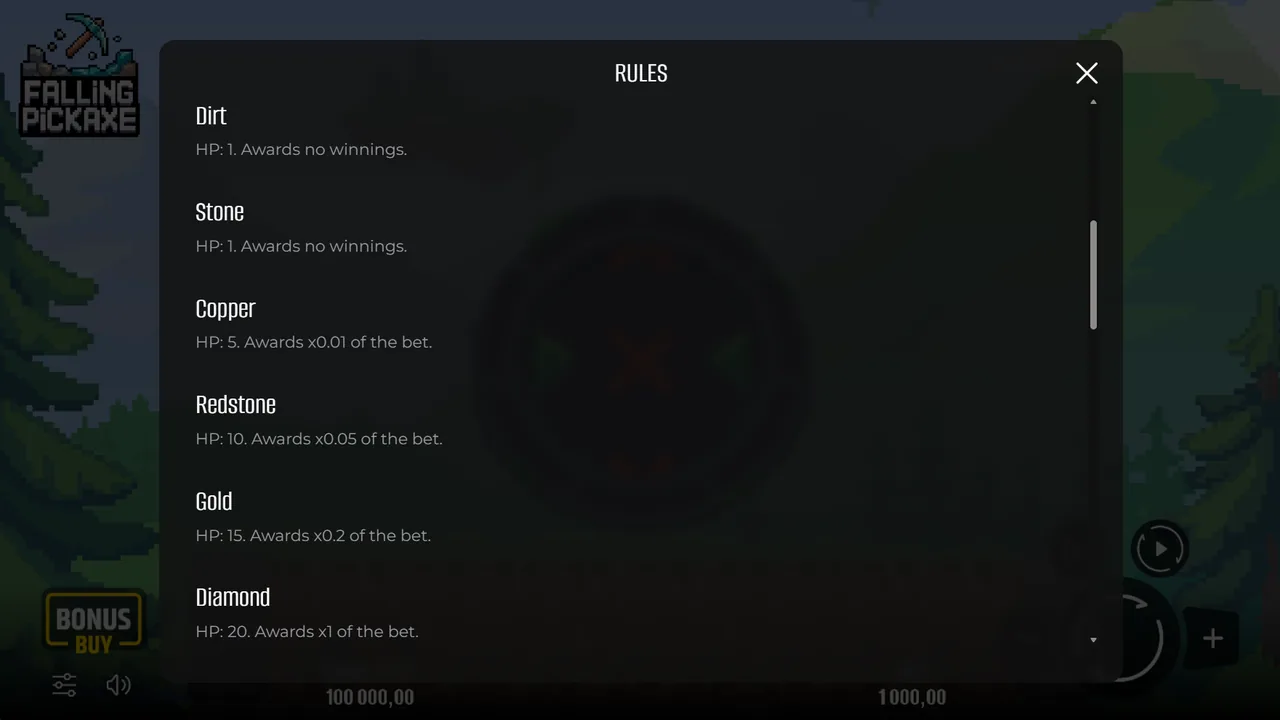
Dirt and stone in the demo have 1 HP and do not pay. They only spend durability. Copper gives x0.01, redstone x0.05, gold x0.2, diamond x1, emerald x5. These are shares of the practice stake for a destroyed block, not a gift for the fact that you have not put money in yet.
Two practice descents of one and the same length can be worth different amounts. Counting depth in cells as a multiplier is useless in the demo too. Look at the type of block. An emerald on short wood can overtake a long empty pipe.
The x5 of a block and x160 of the whole round are still different shelves. The Pixmove card does not raise the ceiling because you are in practice mode. If the panel shows otherwise, the panel is the correct one.
The table below is taken from the screens of the rules. It is needed so that in the demo you check your eye, and not so that you learn a “system” by heart. There is no system here. There is the makeup of the shaft, which you do not choose.
| Block | HP | Reward from the stake |
|---|---|---|
| Dirt and stone | 1 | none |
| Copper | 5 | x0,01 |
| Redstone | 10 | x0,05 |
| Gold | 15 | x0,2 |
| Diamond | 20 | x1 |
| Emerald | 30 | x5 |
The stake in the Falling Pickaxe demo changes the amounts
Raise the denomination in the demo and the numbers beside the gold will grow. This is not a hint to stake more on money. This is a check that you understood the share of the stake.
The ceiling of x160 at a larger practice denomination remains a ceiling. The amount on the screen grows, not the generosity of the model.
TNT and the crafting table in the Falling Pickaxe demo
In the demo it is easy to sit through ten launches without an explosion and without a crafting table. This is not a bug of the practice version. TNT removes a radius on a descent that is already under way. The arrow, for a time, widens the pickaxe to 1.5, then to 2 and to 2.5, if you hit it again while the effect is still alive. The crafting table repairs HP and can raise the level all the way up to diamond.
Not one of the three objects is bought by a paragraph, and not one is called up by a command. There is no Buy Bonus price on the card. If such a button is in the client after all, read its terms there, not in this text. The demo does not create this price.
A wooden pickaxe in one practice spin can reach diamond level if crafting tables turn up along the way. The word “can” is honest. They may also fail to turn up. The help does not promise to store the level between practice rounds.
Look at the help on pause. The first screen is usually about the types of pickaxes and the reserve. The second is about the rewards of blocks. The third separates emerald, TNT, and the crafting table. This is more useful than driving the acceleration blindly.
The Falling Pickaxe demo against crash and mines
The Falling Pickaxe demo is not worth measuring against the practice slots of big studios. The round there is a different one. Short formats are closer, and even their demos are arranged differently.
In crash you train the moment of exit even on chips. Cash out early and it is a shame; too late and it is often zero. In mines you choose a cell even on chips and you stop yourself. A mistake on a cell ends the round. Minedrop usually has an upper grid plus a field. A general picture of a mine does not carry the table across.
In this demo there is nothing to train except the eye. You do not choose when to exit, and you do not choose a cell. You watch whether the HP will last until a valuable block. The skill “I learned it in the demo” is almost empty here. The skill “I understood the screen” is not.
I do not put other people's percentages into the table. Crash and mines on your platform have their own cards. They do not make practice Falling Pickaxe more honest or more generous. Compare who runs the round.
| Format | Who runs the round | Early collection | What to compare |
|---|---|---|---|
| Falling Pickaxe | The pickaxe goes by itself | Not in the rules | Durability and blocks |
| Crash | The player waits for a multiplier | Usually there is | The exit moment, not the mine |
| Mines | The player opens cells | The player stops on their own | Cell choice, not the fall |
| Minedrop | A different scheme of the round | Does not carry over | Only the picture of the mine |
Skill from the Falling Pickaxe demo almost does not carry over
From a crash demo people carry away the habit of pressing in time. From here there is nothing to carry away except the reading of the blocks. A button for exiting in the middle is not described in the rules of Falling Pickaxe.
If you are already bored on chips, a stake does not cure the boredom. It only puts a price on the same descent.
What the Falling Pickaxe demo cannot do
It does not measure RTP 95%. It does not predict the next paid round. It does not get around a regional block with someone else's build. It does not turn virtual rubles into live ones.
It does not replace the limits of the operator. The minimum and the maximum of the stake on the Pixmove card are empty, and the practice window does not fill them in for the studio. The figures on the panel matter more than any retelling.
It does not make low volatility into a “safe evening”. Low on the card is about the spread of the model, not about a practice series being obliged to end in the plus. On money the same Low easily goes into the minus.
And it is not a licence of the platform. One paragraph, and that is enough. The demo shows the game. The cashier and its rules you read already at the operator, if you have decided to stake.
Registration and the Falling Pickaxe demo
An account and a deposit are easy to glue together in your head, because both ask for a form. For Falling Pickaxe these are different doors. Registration may be needed so that the operator remembers the practice balance. A card is not needed at that moment. If the field already asks for a top-up amount, you have left the demo, even if the word demo is still hanging in the menu.
Guest mode, if it exists, is convenient for exactly one thing. To look at the reel and the first zero HP without email. It is not obliged to store the history of practice descents. You closed the tab, and the session may have disappeared. This is not a loss of money. There was nothing there to lose.
The same name of the game at two operators does not mean the same shell of the demo. Somewhere the help is on one screen. Somewhere they hide it behind an icon. The maths of the pickaxe does not change with the shell, but it is easy to miss the numbers on the blocks in a tight mobile frame. That is why the first descent is without acceleration, on that screen where the HP bar is not cut off.
And do not mix up the language of the button. The English demo and the Russian demo lead into one practice circuit, if Falling Pickaxe from Pixmove is under them. Another pickaxe in another lobby with the same word demo is already not this breakdown.
If after you log in the balance is live straight away and the debit button looks like a deposit, stop and find the switch of the practice account. Do not start “just a little on the minimum” until you have seen the virtual sign. The minimum debits too. The demo differs exactly in this: there is nothing there to debit. While the sign is virtual, you can calmly watch the pickaxe break and not confuse a practice zero with the loss of your own money. That is the whole point of the practice window. This mode promises nothing more than that. Remember this before a deposit.
When to close the Falling Pickaxe demo
Close the demo when you can name four things out loud. Which pickaxe came up. How much HP there was at the start. Which block gave a number. At what moment the bar sat down at zero. If that is there, the screen has been read. Further practice clicks only burn time.
Write down the limit of the amount and of the time before the move over to money, not after a series of pluses in the demo. Short rounds are easy to press one after another, and the rhythm of the chips carries over onto the cashier too smoothly. Before money, the limit is better taken from the page responsible play in Falling Pickaxe.
Before a paid click, check once more the name Falling Pickaxe and the Pixmove label. The partner button of the guide opens the operator, not the site of the studio. The practice breakdown is signed by the author of the materials about Falling Pickaxe.
If the mechanics grew boring on the practice account, do not hope that your own money will make them deeper. They will add the cost of the same fall. That is enough to decide.
- Open the demo and check the name Falling Pickaxe.
- Find the stake, the HP bar, and the button of the rules.
- Go through one descent without acceleration down to zero.
- Name the block that gave the last figure.
- Only then decide whether a stake is needed.
- Demo and the Russian demo are one practice mode.
- A virtual result is not withdrawn.
- The pickaxe falls by itself in the practice window too.
- Dirt and stone spend durability, and they do not pay.
- The “Play” button on the guide does not launch the demo.
A plus Falling Pickaxe demo promises nothing
You closed the practice window in the plus and at once opened the cashier — a classic trap of the short rhythm. The next round does not know about the previous one.
A minus demo session is also not a signal that “now it is obliged to pay out”. Neither chips nor money work that way.
How to read the Falling Pickaxe demo without haste
Practice Falling Pickaxe is convenient also because a mistake in reading the interface costs nothing. You can miss the number beside the gold, open the help, and run the descent once more. On money that same inattention has already been debited.
It makes sense to notice separately where the acceleration button stands. At high speed the fall looks like one flash, and it seems that the multiplier arises by itself. At ordinary speed it is visible which block gave which share of the stake.
Comparing two operators in the demo makes sense only by the shell: where the stake is cut off, where the help is on one screen, where someone else's window gets in the way. The shell does not substitute the maths of Falling Pickaxe.
When the field has been recognized, the guide is no longer needed as a replacement for the client. It is needed as a map: the rules of the round, the mechanics of the objects, the reading of 95% and x160. The decision about a deposit is made already at the cashier.
Frequently asked questions about Falling Pickaxe
Is the Falling Pickaxe demo free?
Yes, if the platform opened a practice account. The result does not arrive on the card.
Does the word demo here refer to the same game?
Yes. Demo and the Russian demo are one practice mode of Falling Pickaxe, not another version of the rules.
Is registration needed?
Not always. Guest entry is decided by the operator, not by the Pixmove card.
Can the rubles on the screen be withdrawn?
No. This is a label of the virtual balance.
Does the button on the guide launch the demo?
No. “Play” opens the partner. Look for the practice window in the client.
After the transition, the game will open at the partner. On the screen is the same type of descent: a pickaxe, blocks, and a reserve of durability. This is not a reference guide on this site.